
For HR teams, demonstrating the return on investment (ROI) of language training can often be a challenge. Frequently, scattered information, subjective indicators, and a lack of traceability make it difficult to justify budgets and communicate results to the organization.
The Bridge HR Portal addresses this problem with a clear approach: objective data, actionable reports, and complete visibility into employee progress.
Progress by Levels: The Clearest ROI Metric
Progress by Levels: The Clearest ROI Metric
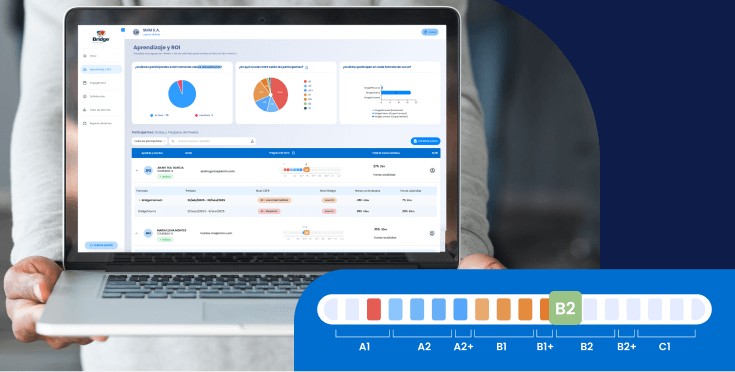
In addition to the traditional CEFR levels (A1–C2), Bridge uses its own scale made up of 18 micro-levels that allow for more detailed progress tracking within each level.
This means that HR no longer just sees if an employee has moved “from A2 to B1,” but also how they progressed within the level, for example:
-
from B1.1 to B1.2,
-
from B1.2 to B1.3,
-
or from consolidated B1 to advanced B1.
This level of granularity, aligned with the CEFR and the Global Scale of English (GSE), enables the measurement of real progress, even when a full level has not yet been completed—something particularly useful in 6-month or 1-year programs, where micro-progresses are essential to justify the investment.
Thanks to this more detailed scale, the HR Portal can show:
-
Progress within the level, not just jumps between levels.
-
Micro-progresses accumulated that demonstrate continuous improvement.
-
Clear traceability of linguistic development, useful for evaluations, audits, and internal committees.
Full Visibility in the HR Portal
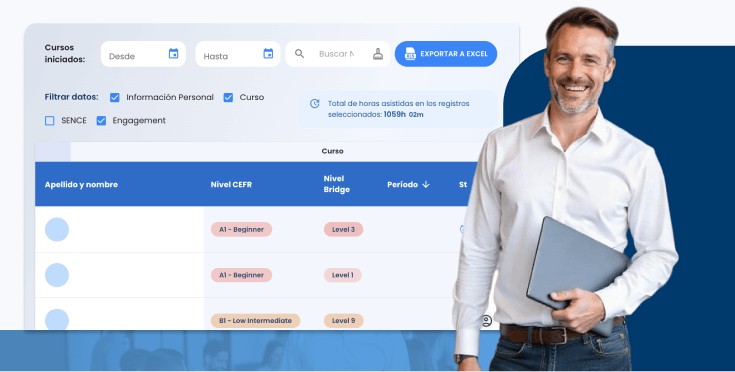
The HR Portal records and displays this progress in a measurable way, allowing HR to analyze:
-
How many levels or micro-levels each employee has advanced.
-
Average progress by area, region, or cohort.
-
Current distribution of linguistic talent (percentage in A1, A2, B1, B1.2, B2, etc.).
-
Assisted hours and participation frequency, which allows correlating engagement with results.
All of this information is available for download in Excel and can be integrated with Business Intelligence (BI) tools for more complex analyses, such as linking progress with performance, retention, or productivity.
Detailed Information from LinguaLevel: Beyond the Number
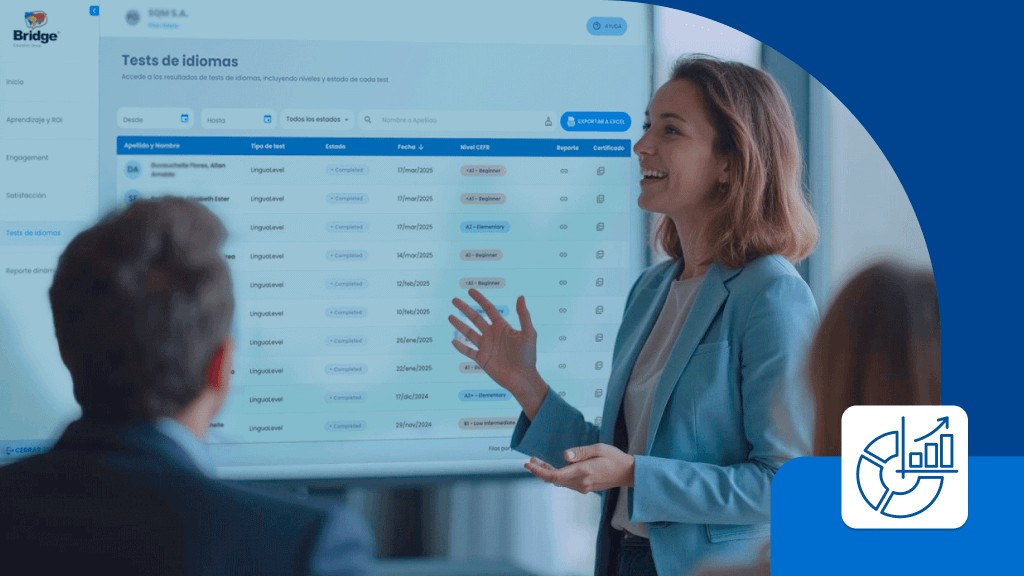
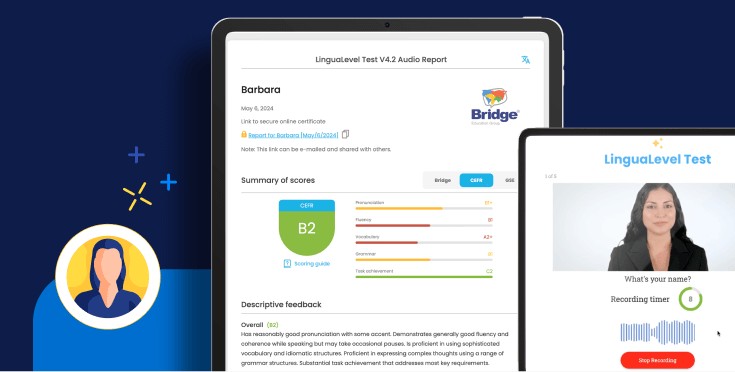
The HR Portal includes a section dedicated to language tests, where teams access updated results from the LinguaLevel test. These reports combine quantitative metrics with qualitative evidence, offering a more comprehensive understanding of progress.
Each evaluation includes:
-
CEFR level and the Bridge level achieved.
-
Audio or video recordings of the employee’s responses.
-
Individual feedback provided by Bridge evaluators.
-
A direct link to the full report for audits or internal reviews.
This level of detail allows HR and area leaders to identify which competencies are being strengthened (speaking, listening, pronunciation, fluency) and validate the quality of learning beyond attendance or participant perception.
Engagement Monitoring: The Other Side of ROI
The impact of training also depends on the level of employee engagement. The HR Portal includes indicators that allow monitoring of:
-
Participation and attendance by course and employee.
-
Hours dedicated to learning, both in classes and practical exercises.
-
NPS and CSAT, which measure satisfaction and perception of the program.
These data points allow for the timely identification of low engagement risks, adjusting strategies with managers, or adapting modalities to maximize program usage.
Dynamic Reports and Customization for Strategic Decisions
The portal’s Dynamic Report allows advanced filters by area, country, level, course type, or period. This enables HR to generate professional reports in minutes and analyze them in committees or planning meetings.
Frequent Use Cases:
-
Justifying the continuity or renewal of a program.
-
Comparing results across locations or business areas.
-
Identifying talent with B2/C1 levels for internal mobility or global roles.
-
Preparing reports for headquarters with objective, auditable evidence.
Official Certification: Evidence for Files and Audits
Upon completing a level, each employee receives an official Bridge certificate, validating the level achieved. This certificate can be added to training records, performance processes, compliance audits, or professional development folders.
This certification closes the learning cycle with a verifiable milestone, especially valuable for companies with formal language policies or headquarters requirements.

A Control Center to Successfully Monitor Progress
The Bridge HR Portal transforms measuring the ROI of English training into a clear, data-driven process. With precise progress indicators, detailed tests, dynamic reports, and official certifications, HR teams can demonstrate with evidence that the investment translates into:
-
More competent employees.
-
Teams better prepared for global environments.
-
More efficient and collaborative processes.
-
Better results for the business.
Level progress stops being an isolated data point and becomes a strategic indicator of the real impact of training.
Learn more ways to leverage the HR Portal to demonstrate the real impact of your language programs.