
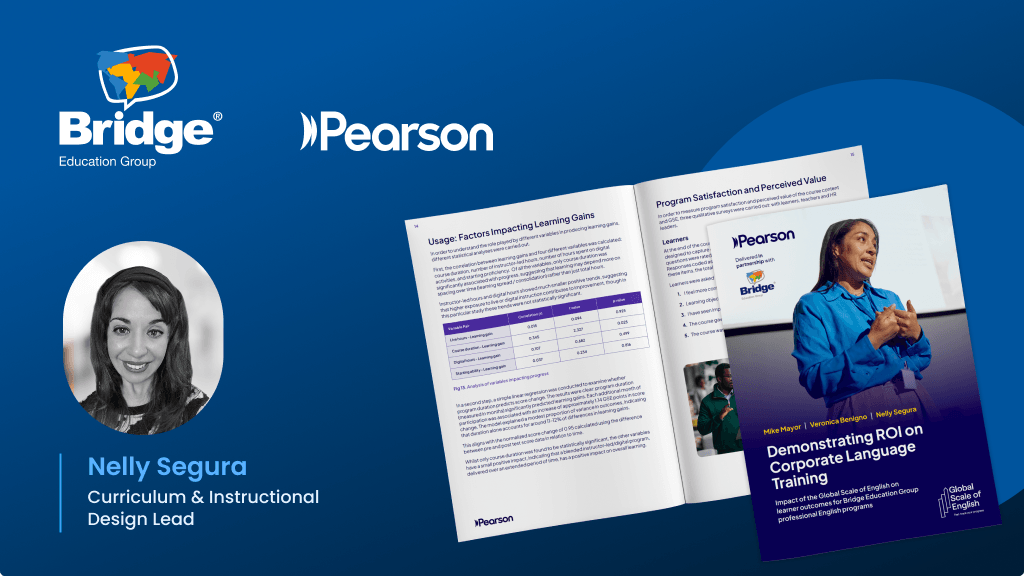
For any HR team investing in language programs, the question is always the same: how do we know it’s actually working? That was the starting point for the joint study between Bridge and Pearson, led academically by Nelly Segura, Academic Lead of Curriculum & Instructional Design at Bridge. We spoke with her about how the study came about, what they found, and what it means for the companies that trust these programs.
The Origin: Moving Beyond Perception
Bridge and Pearson’s relationship goes back years, built on tools like Business Partner and the Global Scale of English (GSE). But this particular study began with a conversation with Mike at the IATEFL conference in Edinburgh.
Behind it was a question Segura had been carrying from her academic role: attendance, satisfaction, and course completion are useful data points, but they don’t prove learning. On top of that, CEFR levels are too broad to capture the progress someone can make during a relatively short corporate program.
“My goal was to build a more complete and rigorous view of our programs’ impact.“
So she proposed combining real data from corporate students with multiple sources of evidence: digital content performance, progress assessments, and the perspectives of students, teachers, and HR representatives.
The Key Finding: Time Matters More Than Hours
One of the results that most struck Segura — relevant to any team designing or budgeting training programs — was that program duration turned out to be the strongest predictor of progress, even more than the number of class hours or digital practice.
“Language learning doesn’t happen through a quick fix or simply by accumulating hours.“
For HR, this has a direct takeaway: short, intensive programs tend to underperform compared to programs sustained over time, even if they involve fewer hours per week. It’s a useful data point when deciding how long a training investment should run.
From Evidence to Program Design
The study confirmed that the GSE shouldn’t be used only to report results at the end of a course, but as a framework that connects diagnosis, learning objectives, content, teaching, and assessment from the very start.
It also reaffirmed the move toward more personalized programs, based on needs analysis and each student’s specific professional goals. This means preparing teachers for more than just delivering content: they need to learn to interpret progress evidence and adjust their teaching based on data.
What’s Next: Learning Language to Apply It at Work
Perhaps the point of greatest interest for HR is where this is headed. The study gives Bridge a foundation to keep developing hyper-personalized programs and to integrate professional skills — the so-called Power Skills — into language teaching. The next step, Segura says, is to connect language progress more directly to its real-world application at work.
What This Study Leaves Bridge With
Asked to sum up what this study means for Bridge students, Segura didn’t hesitate:
“Our students’ progress is real and measurable, even when it doesn’t yet show up as a full level change.“
A summary that also captures the spirit of the study: moving from perception to evidence, and from evidence to designing programs that are more relevant to the real needs of companies and their teams.
Want to see the full study? Click here to explore all the findings.