What "Accredited" Can Mean

There is no single global standard for TEFL certification, and the word "accredited" is used to describe several distinct kinds of evaluation. Some evaluate an institution as a whole; some review a course or syllabus; some concern qualifications frameworks; some assess business practices rather than education.

The distinctions matter, because they determine what a credential actually attests to. They are explained below, followed by a precise account of what Bridge holds.

Four Kinds of Evaluation

Institutional accreditation

An evaluation of the organization itself — its governance, finances, staff, student outcomes, and record-keeping — typically involving site visits and a continuing multi-year review cycle. In the United States, the accreditor itself must be recognized by the U.S. Department of Education. This is the most comprehensive form of review in the field.


Course-level quality assurance

An evaluation of a course or syllabus against a published framework. Often rigorous and valuable, it reviews materials rather than the institution behind them; the reviewing body may or may not be recognized by a government authority.

Qualification regulation

In the United Kingdom, a government regulator (Ofqual) oversees awarding organizations — the bodies that design qualifications and issue certificates. Those bodies, in turn, approve training companies to deliver courses leading to their qualifications. What is regulated is the qualification and the awarding organization; a training provider may accurately say its course leads to a regulated qualification, which is a different statement from the provider itself being regulated.

Credit recommendation

An academic body reviews a course and recommends the university credit it should carry. This is not accreditation; it is a separate, additional evaluation, and the one that determines a course’s academic currency.

The Distinctions Worth Checking

When weighing any accreditation claim, four things are worth establishing:

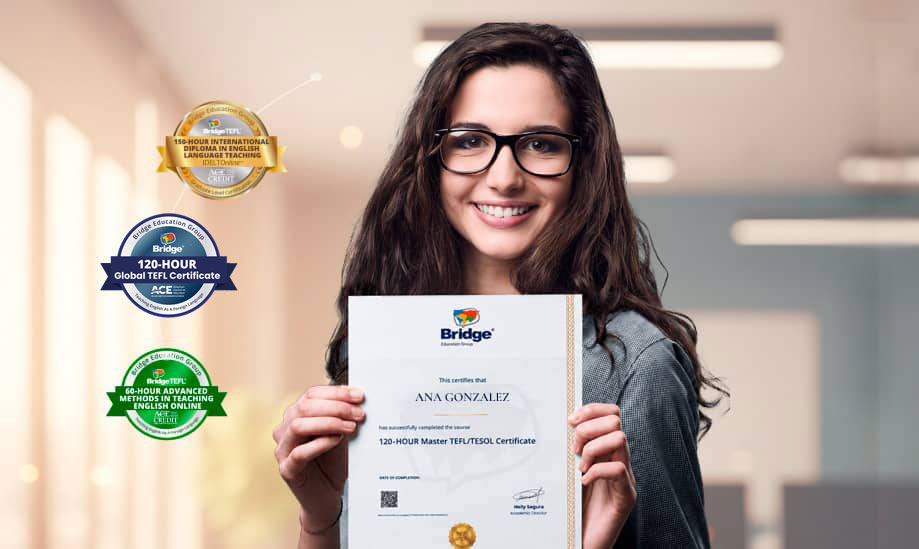
Teacher holding a Bridge TEFL certificate in a classroom

Whether the institution is accredited or only a course reviewed.

Whether the accreditor is recognized by a government authority.

What the credential’s issuer says it certifies, in its own words.

Whether the claim appears on an independent register.

What Bridge Holds

ACCET

Institutional Accreditation

Bridge Education Group is institutionally accredited by ACCET — the Accrediting Council for Continuing Education and Training — which has been recognized by the U.S. Department of Education as a reliable authority on educational quality since 1978. The accreditation applies to Bridge as an institution, not to a syllabus alone. The review includes on-site visits, analysis of financial statements, quality standards equivalent to ISO 9001 certification, and a continuing four-stage cycle of self-evaluation, peer review, and independent commission decision. Accreditation of this kind is maintained, not merely obtained.

The .edu Proof

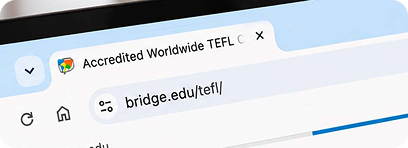
Bridge’s domain is bridge.edu. The .edu domain is restricted to educational institutions meeting accreditation standards recognized by the U.S. Department of Education; its use is itself a verifiable marker of institutional standing.

bridge.edu/tefl/ in a browser address bar
AQUEDUTO

Specialist Quality Assurance

Bridge is additionally evaluated by AQUEDUTO, the Association for Quality Education and Training Online — a specialist body that assesses online and blended teacher training against a published framework covering institutional strategy, course design, tutor competencies, and technology. Bridge met the AQUEDUTO standard in every category evaluated, alongside organizations including the British Council, NILE, and International House. AQUEDUTO provides specialist quality assurance for online training; it is additional to Bridge’s institutional accreditation, not a substitute for it.

University credit recommendation

Select Bridge courses have been reviewed by the American Council on Education (ACE) and recommended for undergraduate or graduate university credit, transferrable to more than 1,600 universities. The 120-Hour Global TEFL Certificate is recommended for 9 undergraduate credits; the IDELTOnline™ for 6 graduate-level credits. ACE review is separate from accreditation: it is the evaluation that determines whether professional training carries academic currency, and it is uncommon among TEFL providers.

American Council on Education

Course Levels and Credit at a Glance

Two systems, one question.

The United Kingdom describes course level through qualification frameworks; the United States through university credit. Bridge is a U.S. institution, and its courses carry credit recommendations from the American Council on Education, shown in the middle column. For readers who think in UK levels, the final column offers an indicative comparison — Bridge’s own mapping, derived from the ACE recommendations, not an Ofqual determination.

Bridge Course What It Carries (ACE Credit + CEUs) Indicative UK Level (RQF) Open course
IDELTOnline
150 hours
6 graduate-level credits · up to 15 CEUs · pathway credit at Bridge university partners Level 7 (indicative)
120-Hour Global TEFL Certificate 9 undergraduate credits · up to 12 CEUs Level 6 (indicative)
Specialized Certificates Four courses at 3 undergraduate credits each (TEO Foundations, TEO Advanced Methods, Foundational CLIL, Advanced CLIL) · select Crown College transfer · up to 6 Level 5 (indicative)
Foundational Certificates
40, 60, 100 hours
40-Hour: 3 undergraduate credits · 60-Hour: 4 undergraduate credits · 100-Hour: 6 undergraduate credits · 1 CEU per 10 hours -
Micro-credentials
10–30 hours
Select Crown College transfer · up to 3 CEUs Level 4 (indicative)

Where to Verify

Each of Bridge’s credentials is a matter of public record and can be confirmed at its source:

Hands typing on a laptop with ACCET, ACE, and AQUEDUTO logos

Bridge Education Group on the ACCET register of accredited institutions.

accet.org

ACCET’s recognition on the U.S. Department of Education’s database of recognized accrediting agencies.

ed.gov

The AQUEDUTO framework and membership on AQUEDUTO’s site.

aqueduto.com

The same registers list any accredited provider.

Our Affiliations

Bridge partners with universities in the U.S. and abroad to offer joint TEFL certification, scholarships, university credit, and pathways to graduate degrees. IDELTOnline credit may be applied toward a graduate certificate, master’s program, or scholarship at our Pathway Partners.

FAQs

Yes. Bridge Education Group is institutionally accredited by ACCET, the Accrediting Council for Continuing Education and Training, which is recognized by the U.S. Department of Education. Institutional accreditation means Bridge itself — its governance, finances, staff, and student outcomes — is reviewed, not just its course materials. Bridge is additionally evaluated by AQUEDUTO for online and blended training quality, and select Bridge courses are recommended for university credit by the American Council on Education.

ACCET is the Accrediting Council for Continuing Education and Training, a U.S. accrediting body recognized by the U.S. Department of Education as a reliable authority on educational quality since 1978. Recognition matters: any organization can call itself an accreditor, but only a small number are recognized by a government authority. You can confirm ACCET’s recognition on the Department of Education’s own database of recognized accrediting agencies.

An accredited institution has been evaluated as an organization — its finances, governance, staff, student outcomes, and record-keeping — typically including site visits and a continuing multi-year review cycle. An accredited or quality-assured course has had its materials reviewed against a framework. Both have value, but they are not the same claim, and providers frequently describe the second as though it were the first. Bridge holds institutional accreditation from ACCET.

No. Ofqual regulates awarding organizations in England; it doesn’t regulate course providers, and it has made no determination about Bridge courses. Bridge is a U.S. institution: our courses carry credit recommendations from the American Council on Education, which is the U.S. system’s equivalent measure of academic level. Where we show UK level comparisons, they’re our own indicative mapping derived from those ACE recommendations — useful for readers who think in UK levels, but not a credential we hold.

The Bridge centers in South America and our partners abroad are not accredited by ACCET, but are accredited by or affiliated with varying regional or local accrediting or regulatory agencies. ACCET accreditation covers Bridge Education Group, USA, and our online TEFL/TESOL certification courses.

AQUEDUTO — the Association for Quality Education and Training Online — is a specialist body that evaluates online and blended teacher training against a published framework covering institutional strategy, course design, tutor competencies, and technology. Bridge met the standard in every category evaluated, alongside organizations including the British Council, NILE, and International House. To be precise: AQUEDUTO is specialist quality assurance, not government-recognized institutional accreditation. It’s additional to our ACCET accreditation, not a substitute for it.

No. Accreditation is a quality evaluation of an institution or a course. An ACE credit recommendation is an academic evaluation of what a course is worth in university credit — it’s the American Council on Education, the coordinating body for U.S. higher education, saying your training deserves academic recognition. They’re different evaluations answering different questions. Bridge holds both, which is unusual in TEFL: the 120-Hour Global TEFL Certificate is recommended for 9 undergraduate credits, transferrable to more than 1,600 universities.

The .edu suffix is restricted to educational institutions meeting accreditation standards recognized by the U.S. Department of Education. It isn’t a marketing choice — it’s a registration requirement. Bridge is bridge.edu, which is why the address bar is the fastest credential check available to you, on any provider’s site.

Please do. Look up Bridge Education Group on the ACCET register; confirm ACCET’s recognition on the U.S. Department of Education’s database of recognized accrediting agencies; read the AQUEDUTO framework on AQUEDUTO’s own site; find any Bridge course in the ACE National Guide; and check the address bar. Every link is on this page — and the same checks work for any provider you’re considering.

Yes. Bridge certificates are accepted by schools, language institutes, and online teaching platforms worldwide, and every certification is issued as a Credly digital credential any employer can verify instantly. Recognition follows verifiability and the standing of the institution behind the certificate — which is what institutional accreditation, and this whole page, is about.

A Matter of Record

Bridge’s accreditation and credit recommendations are public, independent, and verifiable at their sources — and prospective teachers are encouraged to consult the registers directly. When you are ready, we would be glad to help you choose the right course.

A student taking notes while studying online
Loading…