Bridge TEFL
  Expert Series Webinars
  BridgeUniverse Blog
  TEFL Jobs
  Language Training
  About Bridge






The Test of English as a Foreign Language (TOEFL) is a standardized test that schools and programs use for admissions and placement around the world. Teaching TOEFL test prep is a great niche for English teachers, because a high demand exists for teachers who help students succeed on this popular exam. Let’s take a closer look at what the exam entails, who takes it, and how you can start teaching TOEFL exam prep.
If you’re new to teaching, you’ll want to get initial training and qualification with a TEFL certificate. You can explore our online TEFL courses to get started!
What should teachers know about the TOEFL exam before teaching it?
Teaching TOEFL test prep requires a strong understanding of academic English and a clear grasp of how the exam measures performance under time pressure. Teachers focus not only on language development but also on helping students navigate task types, timing, and scoring criteria.
TOEFL teacher jobs are available worldwide, both online and in traditional teaching contexts. ELT professionals can teach TOEFL test prep as freelancers or in language centers and universities. As an American exam with a standardized format, the TOEFL assesses four core language skills in specific ways that teachers must understand in depth. The details below are updated to the new 2026 exam.
Speaking
This section emphasizes concise, real-world communication rather than extended monologues. Test-takers respond to 11 short prompts that require clear organization, accurate language use, and appropriate tone within strict time limits. Some tasks focus on expressing opinions or responding to practical situations, while others require summarizing or reacting to academic content.
Overall, the updated speaking section prioritizes clarity, coherence, and effective spoken communication over length or memorized response patterns. It lasts about 15 minutes.
Reading
The reading section focuses on efficient academic comprehension rather than long, dense passages. Test-takers work with shorter texts and respond to 50 questions that assess their ability to identify main ideas, understand relationships between ideas, and interpret meaning in context.
The updated format places greater emphasis on reading accuracy, vocabulary in use, and strategic processing under time pressure, reflecting how students engage with academic texts in real university settings. It lasts about 35 minutes.
Listening
This section emphasizes comprehension of spoken academic and campus-based English rather than long listening endurance tasks. Test-takers work with shorter lecture segments and conversations and answer the 47 question items that assess understanding of main ideas, supporting details, and speaker intent.
The updated format places greater weight on recognizing organization, following arguments, and processing spoken information efficiently, reflecting how listening functions in real academic settings. It lasts about 35 minutes.
Writing
The new TOEFL writing section consists of three shorter, task-based activities rather than traditional long essays. Test-takers must complete a sentence-building task that assesses grammatical accuracy and word order, followed by an email task requiring a clear, appropriate response in an academic or campus-based context. The final task focuses on academic discussion writing, where students contribute a short, well-reasoned response to a prompt by engaging with ideas presented by others.
Together, these tasks emphasize clarity, coherence, and control of academic English. This part lasts about 30 minutes.
The TOEFL is now offered exclusively as the TOEFL iBT® (internet-based test), which test-takers complete on a computer either at an authorized test center or at home through online proctoring. The former paper-based version has been discontinued, but the test format and scoring remain consistent across both delivery options.
Need help teaching for exams? Get a few tips for teaching English for test preparation.
Who is the TOEFL designed for?
When you teach TOEFL test prep, you’ll see different kinds of students who want to take the exam for a variety of reasons. Some students may be in high school, while many adults also look to take this exam.
Each group brings different goals, timelines, and pressure points, which means TOEFL teachers must adapt their approach to fit both academic and personal stakes.
Here are a few examples of student types you may encounter:
-
One of the most common types of students you’ll see is teens who want to participate in an exchange program in an English-speaking country. Often, schools will require prospective students to take the TOEFL to ensure they will be able to cope with the coursework.
-
There are also cases where your student will need to take the exam to gain admission to college. In the US, it is especially common to require a specific TOEFL score in order to be considered for admission.
-
There is also the case of aspiring immigrants who need to take the TOEFL to get the visa they desire. These students tend to be older.

What are the benefits of teaching TOEFL exam prep?
There are many reasons to consider investing in TOEFL teacher training. Beyond demand, TOEFL exam prep offers a clearly defined teaching focus with measurable outcomes. This clarity allows teachers to plan lessons more strategically and track student progress with precision.
Here are a few of the benefits of getting into this TEFL/TESOL niche.
It’s in high demand.
TOEFL exam prep is in high demand given the large number of people who want to take English courses or go to university abroad.
You can teach from anywhere.
Now more than ever, you can teach TOEFL exam prep online very easily. A hybrid way of teaching and learning has become the new normal.
Is it difficult for you to access a test center? Find out more about English testing at home.
It pays well.
One key advantage of TOEFL teacher jobs is that they pay well. Students have a clear goal and want to invest in enough preparation to succeed on the exam. Teachers who specialize in this area can expect to earn more, on average, than general English teachers.
It’s rewarding.
Teaching is rewarding, and teaching TOEFL test prep is one of the most satisfying niches in ELT. Given that a specific target goal exists (scoring well on the TOEFL exam), it’s easy to plan lessons and orient students so they can achieve their desired grades. Seeing them succeed is one of the best parts of teaching TOEFL test prep.
Not sure what area of ELT you should specialize in? Get tips for finding your TEFL/TESOL niche.
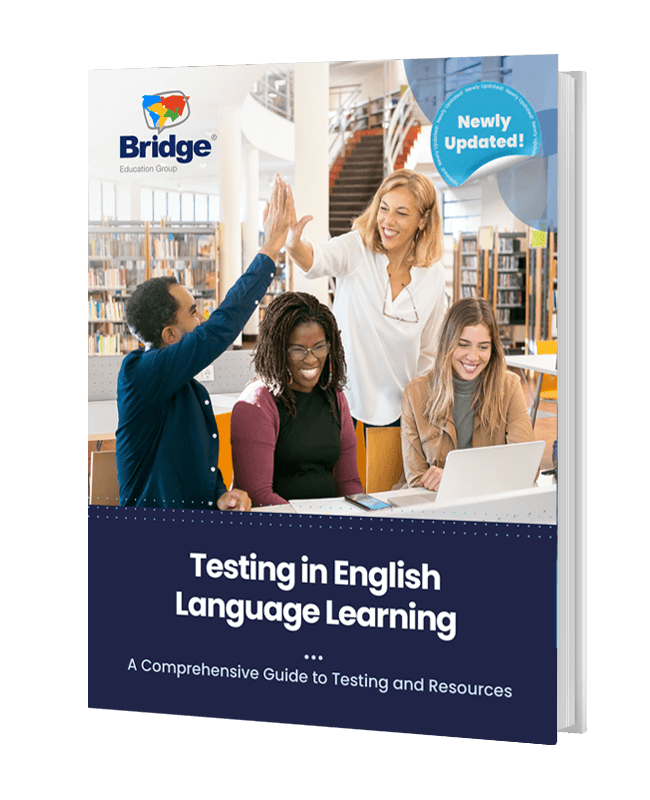
Take a deep dive into the spectrum of English language exams and resources with the free guide to
Testing in English Language Learning
DownloadHow do you start teaching TOEFL test prep?
Getting started with TOEFL test prep involves more than general teaching experience. Teachers need a solid foundation in ELT, familiarity with the exam format, and targeted training that aligns language instruction with test performance.
The steps below focus on the key qualifications and knowledge teachers need to begin working confidently with TOEFL students.
Step 1: Get qualified.
If you’re wondering how to teach TOEFL, then you should take the first step of getting TEFL/TESOL certified. If you’re not already certified, then you’ll first need general TEFL certification of at least 120 hours. A course like the Bridge 120-hour Master Certificate will qualify you for jobs and help you master the basics of ELT, such as lesson planning and using effective teaching methods.
Once you have general TEFL/TESOL training, you should consider taking the revised and updated Micro-credential course in Teaching TOEFL Test Prep, which will provide in-depth training on the exam and give you strategies to help students score high on the test. This credential will also help you stand out to students and employers and can even potentially raise your earning potential.
Step 2: Familiarize yourself with the test.
As mentioned above, the test has four different sections (reading, writing, speaking, and listening) that you need to know well in order to gather the appropriate TOEFL teaching material. Make sure you know each section’s content and duration in order to prepare students adequately.
Keep in mind that different versions of the TOEFL also exist, and you’ll need to know them. You can adapt your lesson plans depending on which test your student is taking. Here’s a breakdown of the test versions:
Step 3: Apply to jobs or search for students.
If you want to work with a company or a language institute, then you can look for open positions on the Bridge Job Board or LinkedIn. If you’d rather freelance, then you can use many ways to find students who want individual or group TOEFL lessons. You can use school boards, social media, or an online ESL marketplace to attract students who are already looking for a teacher.
Teaching TOEFL test prep is straightforward, but it requires commitment and informed preparation. Teachers need the right TEFL/TESOL certification, a solid understanding of the exam, and a clear sense of who their target students are and what those students need to succeed. When these ideas are in place, teaching TOEFL becomes structured and far more effective.
With its clear purpose, defined skills, and measurable outcomes, TOEFL test prep offers teachers a focused way to build expertise and credibility. Preparation shifts from speculation to deliberate, strategic teaching that produces visible results. For teachers who want to specialize, work with goal-oriented students, and support learners pursuing academic and professional achievement, TOEFL test prep stands out as a strong, sustainable teaching path.