Bridge TEFL
  Expert Series Webinars
  BridgeUniverse Blog
  TEFL Jobs
  Language Training
  About Bridge








Josefina Castillo, from Argentina, has taught English for 10 years. She started her career at a language institute but soon found the structured environment did not suit her. She left to become a teacherpreneur and launched her own English institute. She shares the benefits of becoming an independent ESL teacher with anyone considering teaching on their own terms.
If you’re new to teaching, you’ll want to get initial training and qualification with a TEFL certificate. You can explore our online TEFL courses to get started!
- Who becomes an independent teacher?
- 1. You can do what you love because all types of ESL teachers are in demand.
- 2. You are your own boss – teach who, what, how, where, and when you like.
- 3. You can freely express your personality in your teaching.
- 4. You are free to have fun and try something new.
- 5. You can finally make time for yourself.
- 6. You will always feel welcomed and included in the English teaching community – everyone has a place here.
Who becomes an independent teacher?
You might be an experienced English teacher who has taken countless TEFL courses and worked in the industry for years. You get up every day with your lessons ready and head to the institution where you work. You might still feel passionate about teaching, but something does not feel right. Or you no longer want to work for others. You want to work as an independent teacher and be in charge.
Or maybe you’ve just finished your online TEFL course and started as a new teacher at a school or online tutoring company. You have long wanted to teach English, but now you feel disappointed. This structured environment does not match what you imagined. You want freedom. You want control over your own career.
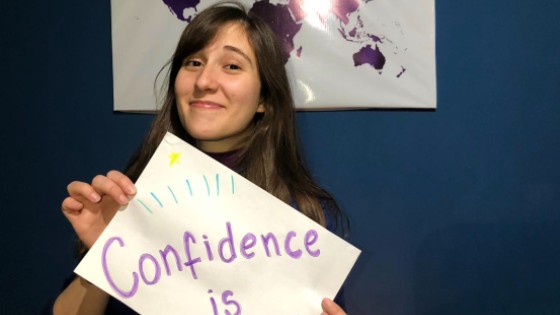
If you are reading this, you probably already feel ready for independent teaching, and one of these descriptions might match your own experience. I understand, because some years ago, before I decided to leave my job and pursue what I loved, I experienced the same situations. I felt frustrated and overwhelmed, trapped in a safe, regular teaching job at a school. I was not fully committed to it, and I knew I was not giving 100 percent.
Teachers have many options for teaching English independently. A freelance ESL teacher works online as a contractor for an online marketplace or language school, choosing their own students, schedule, and teaching niche. Some teachers use this path to find students and start private tutoring. Others, like me, become teacherpreneurs and build their own online English teaching businesses. I specialize in teaching Business English and English for Specific Purposes for adults.
Once I established my business, I continued growing it with full commitment. Becoming an independent online teacher offers many benefits. Consider these reasons to make the change:
1. You can do what you love because all types of ESL teachers are in demand.
Potential students of all ages and backgrounds live all over the world, and they all have different goals for learning English. That means you can match what you love teaching with what students hope to achieve.
Personally, I love working with adults, especially retirees. I enjoy every class we have and the energy they bring to everything they do. As an independent teacher, I always have the chance to pursue my passion.
Retiree students often want conversation lessons to develop skills for travel or family visits abroad, and teachers should design lessons directly around those goals. That kind of match between interest and need is difficult to find in a fixed institutional curriculum. Every independent teacher can build a similar niche around the students they enjoy most.
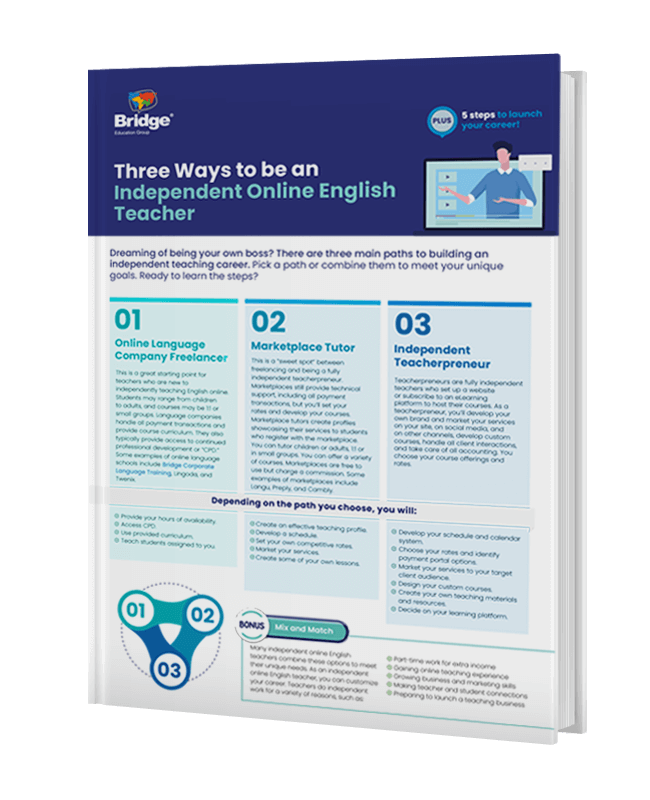
Want to work for yourself? Read the free guide to
Three Ways to Be an Independent Online English Teacher
download2. You are your own boss – teach who, what, how, where, and when you like.
You can choose your ESL teaching niche and preferred student age. You also have the freedom to establish your own rates, curricula, and teaching location, whether at home, a café, or an Airbnb while traveling.
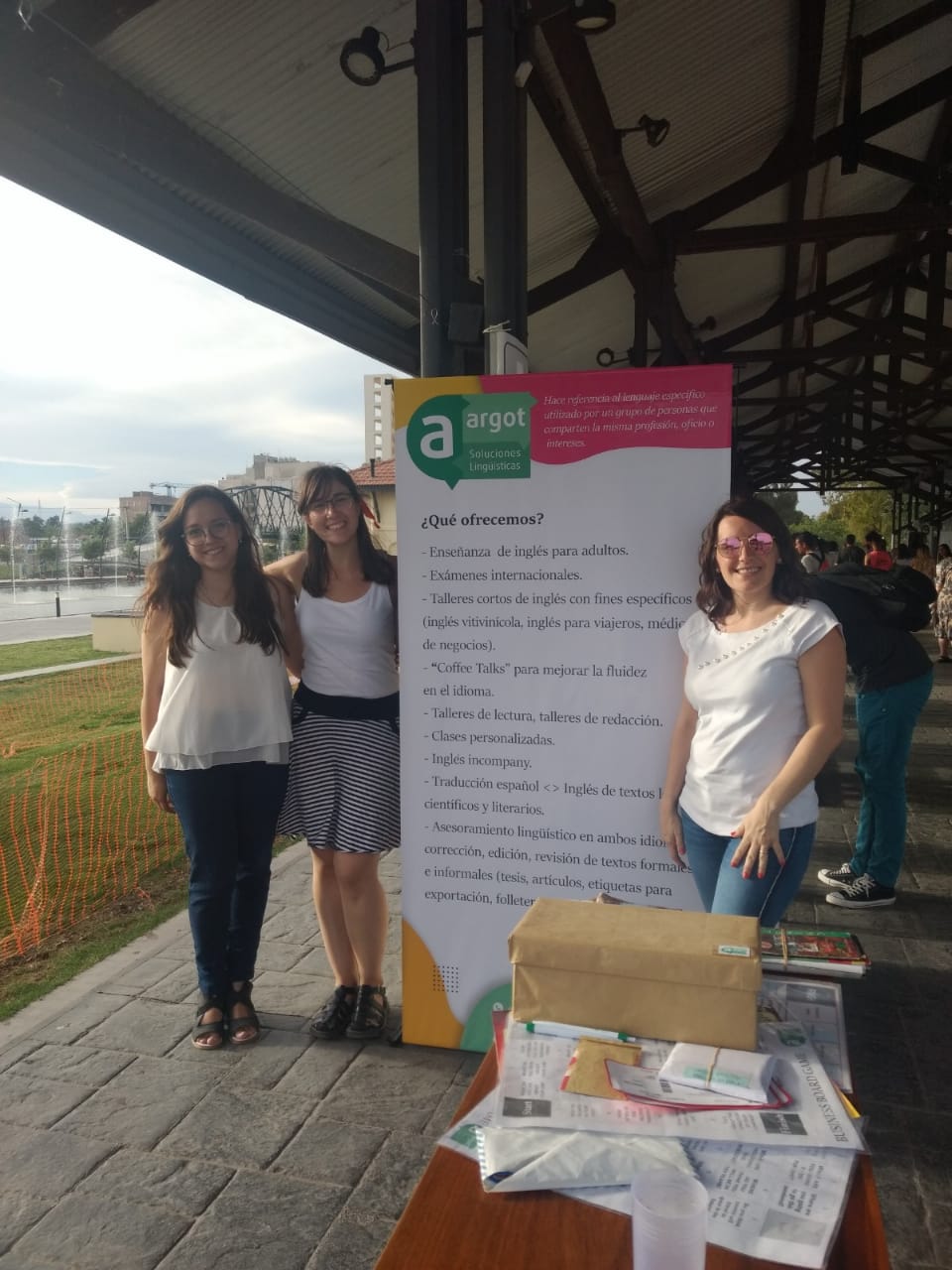
For example, when I worked for a language institute, I taught kids, but that was not the right fit for me. So I became a teacherpreneur and started my own teaching business. I specialized in teaching adults and began offering an online conversation group built around having coffee together. Today, these “Coffee Talks” remain a favorite at my institute.
Independent teachers can test new class formats without asking anyone else for approval. What works can stay in rotation, and what does not can be dropped or adapted for future learners. That kind of direct control over curriculum design is rarely available to teachers working for an institution.
3. You can freely express your personality in your teaching.
As an ESL teacher, your preferences, style, and personality can shape your teaching materials, methods, and processes. You often cannot do this when you work for others.
I have an active, energetic personality, and I enjoy games. Working for myself, I always try to model this energy for my students: staying passionate, taking initiative, and not fearing mistakes.
When a student mispronounces a word or pauses mid-sentence, that moment can become part of the lesson instead of an error to correct and move past. Students relax once they see that mistakes are normal, not something to fear – and that level of comfort often does more for spoken English progress than teachers think.
Explore strategies to build confidence in your ESL students.
4. You are free to have fun and try something new.
ESL teaching jobs are versatile. They keep you constantly challenged and learning new things. In the morning, you might teach kids English, and in the afternoon, you might teach a group of marketing professionals. This variety keeps independent teaching interesting.
Switching between different student groups keeps each day different from the last, even for teachers years into the profession. New activities can be brought into every class instead of repeating the same plan for months at a time. That range is part of what keeps many independent teachers motivated over the long term.
Need more energy in class? Check these fun and easy ESL games for adults.
5. You can finally make time for yourself.
Since you control your own schedule, you decide your daily routine, which means you can finally take that ceramics class you always wanted. Or you can go hiking or start baking. I ultimately decided to buy my first mountain bike and started riding into the mountains and beyond.
You should stay organized and set your own rules from the start.
Independent teachers can set aside fixed hours for personal activities, the same way they set aside hours for teaching. Treating personal time as a fixed part of the schedule is what makes flexibility genuinely useful. Without good work-life balance, teaching can take up every available hour simply because nothing limits it.

6. You will always feel welcomed and included in the English teaching community – everyone has a place here.
English schools, institutions, and companies that hire teachers can set firm requirements, such as a university degree, teaching experience, native-speaker status, or specific citizenship. Teaching independently as a freelancer or teacherpreneur removes these barriers. You can highlight your unique background and skills and determine the course of your own career.
Some institutions still weigh native-speaker status more heavily than teaching ability or classroom experience. Independent teaching removes that requirement, since students judge a teacher on how well they teach, not on where they are from. That shift matters for the many qualified non-native English speakers working in ESL.
My advice: do not ignore your interest in independent teaching. Whatever motivates you to make the change, once you experience the benefits of being your own boss and see the possibilities available to you, you may not want to return to a traditional teaching job.
Independent teaching is not a single fixed path. Some teachers move toward freelance tutoring, some build a full teaching business, and many combine both as their circumstances change over time. Each version keeps the same core benefit: teachers shape the work around their own goals instead of an employer’s structure. For anyone ready to make that change, the right training and credentials make the transition easier from the start.