Bridge TEFL
  Expert Series Webinars
  BridgeUniverse Blog
  TEFL Jobs
  Language Training
  About Bridge







AI tools have many uses for the ESL teacher, but one niche is particularly well-suited to them – Business English. In addition to benefits like simplifying tasks and creating interactive tools, artificial intelligence is revolutionizing Business English instruction by empowering trainers to simplify planning and hyper-personalize their instruction to cater to each student’s professional needs.
FLOW Speak, an AI-powered platform that helps learners build speaking confidence through real-time practice and adaptive feedback, is among the tools leading this change. It is designed for busy professionals and personalizes every interaction to reflect the realities of workplace communication.
Teachers can explore ways to tap into the power of AI to hyper-personalize Business English teaching, from creating adaptable assessments to generating customized lesson ideas and tracking learners’ progress.
If you’re new to teaching, you’ll want to get initial training and qualification with aTEFL certificate. You can explore ouronline TEFL coursesto get started!
- Personalized learning paths
- Adaptive learning systems in student placement
- Personalizing competency-based learning using AI
- Customizing class content and assessment using AI tools
- Personalized AI-generated lesson plans
- AI-powered language apps for personalizing extended practice
- Virtual tutors and chatbots
- Data-driven personalization
Personalized learning paths
At its core, the concept of personalized teaching in English language learning stems from the fact that students learn English for different purposes. When teachers understand their students’ reasons for learning English, especially those learning for professional purposes, and can identify their abilities and skill gaps, they can customize learning paths to meet individual needs. This can also make instructional content, activities, and resources more engaging.
Before the advent of AI tools and machine learning, however, personalizing English classes or developing courses in specific niches like Business English required more time and resources to come up with tailored assessments, curricula, materials, and strategies to make instruction more effective.
Now, using AI paired with adaptive speaking platforms like FLOW Speak, these personalized frameworks become even more powerful. Teachers can map course competencies to the app’s professional speaking scenarios, reinforcing job-specific skills through guided AI practice from the moment their English level is assessed

Adaptive learning systems in student placement
Harnessing AI algorithms to analyze data and detect patterns has benefited adaptive learning, an approach that customizes students’ learning experiences based on their data and performance. Adaptive learning platforms can help teachers by identifying a student’s strengths, learning gaps, and progress in real time, then tailoring the content, difficulty, and pace of instruction to the student’s skills and needs.
One way adaptive learning platforms are used is to conduct placement tests or serve as student assessment tools. In AI-driven English placement tests like Linguaskill, Cambridge English Placement Tests, and Pearson’s Level Test, students are given a question. Then, based on their response, the adaptive program decides on the difficulty level of the next question.
Karina Zew, a Bridge Corporate Language Training teacher, shared how Bridge’s Business English teachers and students benefit from AI-powered assessments to determine students’ English levels.
“If a student answers correctly, the next question will be a little bit harder; if the student struggles, the next question is going to be easier. The software detects the student’s answers and can determine a set of questions that gauge the level of the student more effectively.”
After completing the test, the platform then evaluates the results.
“The student’s answers are compared to a large corpus of linguistics and a large database of users who have answered in a certain way in high-stakes exams and got a certain result,” Zew said.
“Matched against those answers, the AI-run tests can quickly determine a student’s English level. The results are then matched with an international language scale like the CEFR (which is the most widely used set of standards in language placement tests) to be able to describe the student’s speaking, listening, writing, and reading skills.”
Learn more about how you can use AI tools for English language proficiency placement.

Ready to master the terms, technology, and teaching tools used in the virtual EFL classroom?
Specialized Certification in Teaching English Online
Get CertifiedPersonalizing competency-based learning using AI
After identifying the student’s English level, teachers at Bridge Languages can further personalize course objectives and materials using Pearson’s Global Scale of English (GSE) Teacher Toolkit. This tool allows teachers to identify the learner’s profile by selecting the English level and the age group or learner type.
The GSE is mapped to CEFR levels, allowing teachers to interpret test results to provide targeted learning goals. For Business English learners, selecting their job role and the usual tasks they perform at work provides hyper-personalized learning objectives tailored to their job duties.
The teacher can choose which skills (speaking, reading, listening, writing) or areas (e.g., grammar, vocabulary, etc) they’d like to focus on. Afterward, the platform proposes learning objectives and topics you can incorporate into your lessons. Once you’ve selected your course objectives, you can map them to the materials or activities that will help students achieve their learning goals.

Customizing class content and assessment using AI tools
AI-powered content creation and assessment tools are not only beneficial for creating personalized class content but also for making learning experiences more interactive. For starters, teachers can use AI-powered image generators in graphic design apps like Canva or Visme to customize presentations, handouts, and videos. Meanwhile, sites like Quizizz or ClassPoint.ai offer more AI-run teaching assistant tools that can:
-
Generate personalized assessments from a text prompt, document, or webpage,
-
Gamify quizzes and add virtual rewards,
-
Enhance presentation slides or documents with graphics and interactive elements like live polls.
Personalized AI-generated lesson plans
Business English teachers can use AI as their teaching assistants, helping develop or enhance lesson plans to address students’ specific needs or make lessons more engaging. Some of the AI tools you can use include AI assistants like ChatGPT and Google Gemini, and lesson development platforms such as Eduaide.Ai and Education CoPilot, which offer more advanced features, such as templates for gamified lessons and group projects.
Generating lesson plans or class ideas on these apps typically requires using text prompts. Zew, for example, explained how curriculum and lesson designers at Bridge Languages use AI to plan customized lessons and materials for their Business English students.
“We have a set of prompts carefully created to ‘feed’ our best friend, ChatGPT,” Zew said. “Since we know what we are looking for, through those prompts, we can access creative activities that we then use in class. It’s like having a magic tool that understands exactly what we want, and it helps us bring exciting and customized lessons into our classrooms.”
To generate tailored lesson plan ideas, you do have to guide the AI tool itself, which means using well-defined prompts and clear instructions. For this, Zew shared some tips.
“The key is to provide prompts in small pieces. I never ask ChatGPT for a whole lesson. I start with: ‘What’s a good set of open-ended questions to use as a lead-in, fostering discussion, with my B1 level students, in which I plan to include the following text: (transcribe the text)?'”
After ChatGPT generates the open-ended questions, she’ll type in another prompt. “I ask ChatGPT to ‘find in that text three uncommon words, two phrasal verbs, and one idiomatic expression. Provide simple definitions at a B1 level.’ I then wait for the answer and continue with ‘Now create a matching activity in which the words and the definitions are mixed up, for students to match. Please provide the answer key to that.'”
“The key part is to provide step-by-step prompts. Otherwise, AI gets quite confused and offers very vague responses,” Zew said.
Find out about eight ways you can use AI to teach ESL reading.

AI-powered language apps for personalizing extended practice
Language learning apps powered by AI are excellent digital tools for complementing Business English classes and fostering students’ independent practice. By using AI systems like speech recognition, natural language processing, and analytics, these applications can generate human-like conversations in specific contexts, provide real-time feedback, and even track learners’ progress. You can find various language learning apps on the market, but here are some examples:
You can provide your students with information about these apps, which they can download to their mobile phones or computers. Students can use them as extended learning tools to increase their business vocabulary, improve their pronunciation, and practice conversations.
The FLOW Speak app, for example, features speaking and listening practice lessons that students can complete after class hours. Many of the lessons are also geared towards using Business English in various situations, allowing students to learn business expressions and hear how native English speakers talk in the professional world. Through the admin dashboard, teachers can also track and evaluate their learners’ progress in the app.
To extend your learners’ Business English practice, you can also assign lessons on these apps based on what you’ve learned in class. For instance, if your student needs additional preparation for job interviews, you can have them practice describing their work experiences with the speaking AI app after the class. While practicing, the AI tool can give real-time feedback on the student’s pronunciation and provide tips on how to improve their speaking skills.

Virtual tutors and chatbots
Many AI-driven language learning apps also feature virtual chatbots or tutors powered by natural language processing (NLP), speech recognition, and text generation to engage users in simulated conversations. Students can pick a topic they’d like to discuss, and then their virtual conversation partner simulates a text or voice conversation. Several chatbots, like FLOW Speak, Mondly, and TalkPal, also offer other types of interactions, such as role-play or debates, allowing students to practice English in real-life situations.
After the student responds, the AI-powered tool can give personalized feedback in real-time to help improve speaking and grammar skills. The chatbot can give tips on how to pronounce certain sounds better, for instance, or how to apply certain grammar rules. By recommending these apps to your learners, they can continue learning and practicing English outside their usual lessons.
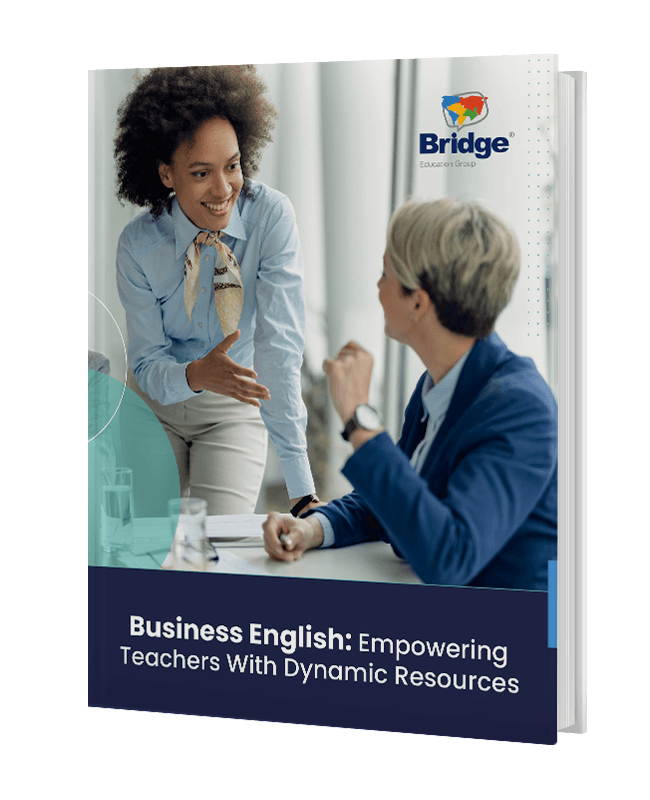
Help your Business English students reach their learning goals with the free guide to
Business English: Empowering Teachers With Dynamic Resources
downloadData-driven personalization
Finally, built-in AI tools in Learning Management Systems (LMSs) or learning platforms can help Business English teachers track learners’ progress based on the data collected from students’ performance in class. After completing tasks or assessments, the platform can then evaluate the results and provide you with progress reports, grades, and metrics that include details like completion rates, accuracy rates, and the time spent on tasks.
The Quizizz app, for instance, generates a report showing every student’s scores on their tasks, completion rates, and the average time taken to answer each question. Meanwhile, FLOW Speak features an admin dashboard that teachers can use to track the number of lessons completed by each student as well as their scores.
With this AI-generated feedback, teachers can identify each student’s strengths and learning gaps and then adjust their instruction accordingly over time. For instance, if the report shows that the learner had many attempts to complete a task, it may mean that the student was still struggling with the concept. You can then decide if the next tasks should be easier or more challenging. Ultimately, the goal is to have the information you need to identify the most effective approach, facilitating the student’s learning and keeping them motivated to progress further.
AI isn’t meant to replace teachers, but it can improve your teaching by providing streamlined access to valuable student performance information, increasing the adaptability of your lessons, and enhancing your content and resources.