Bridge TEFL
  Expert Series Webinars
  BridgeUniverse Blog
  TEFL Jobs
  Language Training
  About Bridge








Argentina offers lush landscapes, exquisite wine, and vibrant nightlife, so it deserves to be on your TEFL bucket list for many reasons. English teachers from around the world – especially digital nomads – flock to this South American region not only because it provides a wealth of opportunities but also because it offers unique experiences, all while they live in a country with a low cost of living.
If you’re looking to teach English in Argentina, this guide shows you the nitty-gritty of what to expect (besides brushing up on your Spanish skills) and what you’ll need to start.
If you’re new to teaching, you should get initial training and qualification with a TEFL certificate, and you can explore our online TEFL courses.
Is there demand for English teachers in Argentina?
Argentina stands as one of the biggest markets for English teachers in South America. Schools and institutes show a huge demand for ESL educators. Most of the jobs appear in its capital, Buenos Aires, where international business and the tourism, restaurant, and hospitality industries remain very strong. Nevertheless, you can also find plenty of opportunities in smaller cities such as Cordoba, Rosario, and Mendoza.
Schools and institutes in Argentina offer positions for teaching young learners and frequently hire teachers to work with adult learners and business professionals across the country, many of whom learn English through language institutes or private tutoring.
The academic year in Argentina runs from early March to December, so the best months to apply fall between February and March or during the second peak hiring season around July and August.
Want to learn more about teaching young learners? Here’s everything you need to know.

What qualifications do teachers need to teach English in Argentina?
TEFL certification
Schools and institutes in Argentina place a lot of value on a TEFL/TESOL certificate when they hire English teachers, as it serves as a main requirement for the majority of TEFL positions. Even if you tutor privately, holding TEFL/TESOL certification gives you a substantial advantage and can open up more teaching opportunities for you in the country.
If you aren’t yet TEFL certified, you can choose an online certification option. The Bridge 120-hour Master TEFL Certificate meets certification requirements to teach English and includes a job advising module, resources, and support. Because the course is self-paced and online, it covers EFL theory and applications in a flexible format.
For those pursuing a TESOL master’s degree, the Bridge 150-hour International Diploma in English Language Teaching (IDELTOnline™) provides more than the 120-hour TEFL qualification and earns credit toward a pathway to an MA TESOL degree.
You can also stand out among the competition by earning additional Specialized TEFL Certifications and Micro-credentials in subjects like Teaching Business English and Teaching English Online, or subjects like Teaching English Pronunciation and Teaching IELTS Exam Prep.

Degrees
In most cases, you won’t need a bachelor’s degree to teach English in Argentina, but some companies may require one. In many situations, a TEFL/TESOL certificate and teaching experience can offset the requirement for a college or university degree.
Prior teaching experience
Many ESL teaching jobs in Argentina prefer applicants with experience. If you’re new to teaching English, you still have options, and you can start getting TEFL/ TESOL experience, even while you’re in Argentina, by tutoring private students, volunteering (there are plenty of opportunities to teach English as a volunteer around the country), or a job teaching English online.
Alejandro, a Bridge grad from Venezuela who moved to Buenos Aires in 2018, began his career as a private tutor before landing his first job at a language institute. “Try to look for any kind of teaching experience, which could be freelancing or working as a private tutor, because it is easier to be hired in a good institute with experience,” he shared.
Visas
The Argentinian government requires a work visa for anyone who wants to work as an English teacher in Argentina, and you’ll need a work contract to apply for one. To secure this contract, you can find English teaching jobs once you’re in Argentina, apply in person (even if you hold a tourist visa), and obtain a work contract when a school hires you.
In general, a tourist visa lets foreign nationals stay in Argentina for up to 90 days. Some teachers work in Argentinian language institutes for a short time with a tourist visa and then renew it every three months, either by briefly traveling to neighboring countries like Uruguay or by going to the immigration office.

How much do English teachers earn in Argentina?
Depending on the company or institution and your qualifications, English teachers in Argentina can earn between $600 and $3,000 USD per month. Online or in-person English teaching rates usually range from $10 to $20 per hour. Full-time teachers at language institutes can earn between $600 and $1,100, while international schools offer salaries from $1,500 up to $3,000.
One of the biggest draws of teaching and living in Argentina is that the cost of living remains relatively low compared to many other countries. With the salaries above, you can live comfortably and cover basic expenses. This comfort, of course, depends on the region, city, or neighborhood where you live (Buenos Aires, for example, ranks as the most expensive city to live in).
Generally, accommodation in Buenos Aires costs $400 to $1,200 per month for a one-bedroom apartment in neighborhoods such as San Telmo, Recoleta, or Palermo. Groceries for one person can cost $100 to $200 per month, and a restaurant meal ranges from $10 to $50.

What types of TEFL jobs are available in Argentina?
Depending on the types of learners you’d like to teach or the institution where you’d like to work, you can choose among different ways to teach English in Argentina.
Some options for teaching include:
-
Language institutes or centers
-
International kindergarten, primary, and secondary schools
-
Tutoring private students
-
Teaching online through ESL companies or privately
The most popular ESL jobs in Argentina are at language institutes or centers, which primarily provide English lessons for adults and Business English students. Working for Argentinian language institutes may have you teaching groups or individuals around 20 to 25 hours a week, and many language institutes can also provide housing to newcomers in the country.
Schools also offer opportunities to teach English in international kindergarten, primary, and secondary schools (also referred to as Polimodals) in Argentina, most of which provide instruction in both Spanish and English. ESL companies in Argentina typically offer 6- to 12-month work contracts.
Many English teachers in Argentina also run independent teaching businesses, tutoring private students to supplement their income. You can also choose to teach English online in Argentina, either through specialized companies for teaching English online or private tutoring.
Because of its low cost of living and generally stable internet speeds, Argentina remains a favorite among many digital nomads. If you hope to explore the country as much as possible without taking a break from teaching, you will likely enjoy teaching virtually while you move around Argentina.
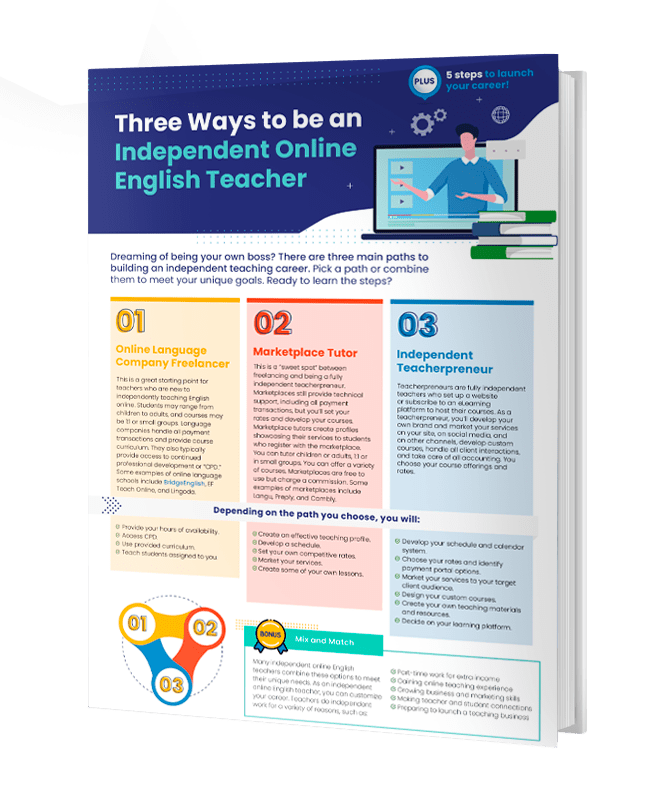
Want to work for yourself? Read the free guide to
Three Ways to Be an Independent Online English Teacher
downloadWhat do teachers say about teaching in Argentina?
English teachers in Argentina often cite Argentinian culture and the learners themselves as key reasons why working and living in Argentina feels worthwhile and enjoyable.
For instance, Anne, a Bridge grad from Great Britain who moved to Buenos Aires around eight years ago, has enjoyed oodles of memorable moments with her students. “The people I meet are very interesting, very varied, and very opinionated. They’re also lively – I don’t feel that I’m banging my head on a brick wall trying to get them to respond!” she recounted.

Meanwhile, Celeste, an Argentinian native who has taught English to kindergarten and college students in her home country, shared some tips for teachers who are new or who want to come to Argentina: “Try to connect with other English teachers and schools in the area. This can help you learn about job openings and get insider tips on teaching – that’s how I got my first job. Also, do a little research on Argentine history, literature, music, and pop culture!”
Teaching English in Argentina offers more than a job – it provides a way to build experience, grow professionally, and live fully in one of South America’s most culturally rich countries. Teachers can easily find steady demand, flexible work options, and a lifestyle that balances meaningful work with exploration and community. If you want to teach, learn, and live in a place that rewards curiosity and adaptability, Argentina gives you a strong reason to stay longer than planned.