Bridge TEFL
  Expert Series Webinars
  BridgeUniverse Blog
  TEFL Jobs
  Language Training
  About Bridge







English teaching is a highly competitive field. International academies, schools, and online companies all look for the best. You have to set yourself apart as an English teacher to secure a coveted position in an international classroom or online. Here are seven ways you can do that.
If you’re new to teaching, you’ll want to get initial training and qualification with a TEFL certificate. You can explore our online TEFL courses to get started!
- 1. Choose an advanced-level TEFL/TESOL certification course
- 2. Earn college credit and CEUs through your TEFL/TESOL course
- 3. Prioritize and highlight professional development
- 4. Choose a TEFL/TESOL niche
- 5. Gain relevant experience
- 6. Build a professional network in the TEFL/TESOL community
- 7. Put together a demo lesson or teaching portfolio
1. Choose an advanced-level TEFL/TESOL certification course
How can you stand out as an English teacher? Start by completing the most advanced TEFL certification you can. Doing so shows hiring managers that you have comprehensive training, and you’ll undoubtedly stand out, whether you’re teaching locally or abroad in competitive markets such as the Middle East.
One of the most advanced online TEFL certifications is the Bridge International Diploma in English Language Teaching (IDELTOnline™), which will enhance your resume with 150 hours of accredited training. The IDELTOnline™ is different from other certifications in that it’s interactive, so you’ll be part of a cohort of trainees from around the world. You’ll have the opportunity to attend live sessions and participate in classroom discussions, similar to other university-level online courses.
This course is unique because you can take it not only for graduate-level college credit but also as a first step toward a master’s degree in TESOL through Bridge’s university pathway partners.
Employers increasingly distinguish between a basic TEFL certificate and one that meets accreditation standards. Most international schools and language centers require a minimum of 120 hours of certification, along with teaching practice, before they consider a candidate.
A shorter or unaccredited course might qualify you for entry-level positions in some settings, but it rarely compares favorably to a fully accredited certification. Choosing the more advanced option from the start means you won’t need to go back and upgrade your credentials later.

Stand out as the most competitive candidate for English teaching jobs with the
International Diploma in English Language Teaching (IDELTOnline™)
Enroll Now
2. Earn college credit and CEUs through your TEFL/TESOL course
Some TEFL/TESOL programs offer college credit, giving you another way to set yourself apart as an English teacher. Many Bridge TEFL/TESOL courses are eligible for college credit. For example, ACE CREDIT® has recommended the IDELTOnline™ for nine graduate-level credits. Those credits are transferable to more than 1,600 universities.
Professional teachers often need Continuing Education Units (CEUs), which are nationally recognized units of measurement for participation in education programs. They’re a great way to stay up to date with the latest English Language Teaching (ELT) developments. Plus, hiring managers will notice them when reviewing your TEFL resume.
Reputable online TEFL/TESOL certifications will help you earn CEUs. For instance, you can earn one CEU for every 10 hours of Bridge course instruction. College credit and CEUs do more than strengthen a resume. If you decide to pursue a bachelor’s or master’s degree later, transferable credits can reduce the coursework you still need to complete.
Licensed teachers moving into ELT from another subject area can often apply CEUs toward the continuing education requirements their state or district already mandates for license renewal.

3. Prioritize and highlight professional development
Many TEFL professional development opportunities are available. The following examples can help you gain employers’ attention.
TEFL/TESOL webinars
Always look for TEFL/TESOL webinars. Not only will you learn about the latest trends in the industry, but you’ll also impress your future employers if you bring them up, as it shows your continued commitment to growing as an educator.
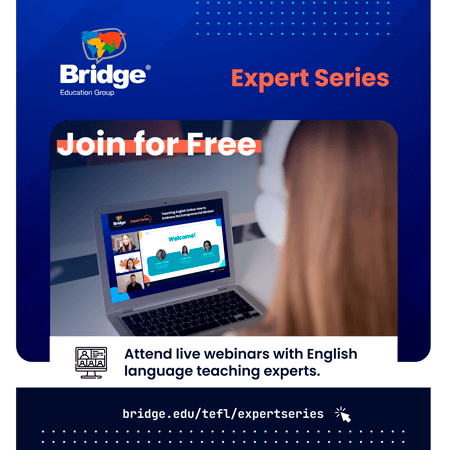
Bridge Expert Series webinars bring ELT industry experts together each month for a live interactive webinar to discuss topics ranging from professional development to teaching methodologies to 21st-century teaching. Register for live webinars or join the community to access over 75 on-demand videos.
Earn a certificate of professional development for every completed lecture while learning new teaching strategies, staying informed about industry trends, and finding valuable teaching and career resources.

Specialized certificates
Talk about any specialized TEFL/TESOL certifications you have whenever you apply for an ESL teaching job. Doing so helps you stand out from other teachers. For example, highlight your Specialized Certificate in Teaching Young Learners if you’re applying to an elementary school abroad. Or, get a Specialized Certificate in Teaching English Online if you want to work for an online company. You’ll stand out by showing that your credentials match the job you’re applying for.
Micro-credential courses
Micro-credential courses provide short, targeted training in specific areas of teaching. For example, you can take a 20-hour course in Teaching English Using Podcasts or a 10-hour course in Games and Activities for the Online Classroom (Young Learners). These courses are a great way to continue earning new credentials, and they aren’t time-consuming. Plus, you can choose a topic you’re already interested in.
Not every form of professional development comes with a certificate. Keeping a short teaching journal, where you note what worked in a lesson and what you would change, shows a level of self-awareness that many employers value just as much as formal coursework. Asking a colleague or mentor to observe a lesson and give feedback works the same way, and it costs nothing.
When you talk about your teaching in an interview, being able to describe specific adjustments you have made based on your own reflection or a peer’s feedback tells a hiring manager you take the work seriously, not just the credential.

4. Choose a TEFL/TESOL niche
Employers and students will really value your skills when you’re a specialist in a certain type of ESL teaching. For example, do you want to focus on teaching business English? Or, maybe you’d like to teach IELTS exam prep classes. Perhaps you’d like to just focus on offering English lessons to teenagers.
Finding a TEFL niche can take a few different forms. Some teachers specialize by age group, focusing entirely on young learners, teenagers, or adult professionals. Others specialize by skill or purpose, such as exam preparation, conversation practice, or workplace communication. A third option is to specialize by format, becoming known specifically as an online teacher or an in-person classroom teacher rather than trying to do both.
Most successful niches combine two of these, such as teaching business English specifically to adults online. Picking a combination that matches both your interests and your existing experience makes the niche easier to build on. Whatever your interests are, choosing one or two TEFL niches to target can:
-
Increase your chances of getting hired by employers looking for specific skills
-
Help you stand out from other teachers on ESL marketplaces
-
Potentially help you earn more, as you’ll be a specialist in your chosen topic
-
Reduce the time it takes to prepare lessons since they’ll all be related

5. Gain relevant experience
Past professional experience is a big factor when you apply for jobs. Try to teach as many lessons as you can before you reach out to hiring managers for a coveted position. Doing so helps you set yourself apart as an English teacher.
You can still get valuable experience through a Guided Teaching Practicum even if you’ve recently completed a TEFL/TESOL certification course and are brand new to teaching ESL. This practicum incorporates hands-on teaching practice in a real EFL classroom (plus you’ll spend time observing other teachers in action).
A Practicum for Teaching English Online will even leave you with a portfolio of recorded classes that you’ve taught to show to potential employers or students. Of course, you can always search for private students in different social media groups or volunteer to teach at refugee centers or local churches.
Whatever route you take to gain experience, keep track of it. Ask your tutor, your practicum supervisor, or even a handful of private students for a short written reference once you finish working with them. A few sentences are enough. These references do not need to be formal, but having two or three ready when you start applying for paid positions gives hiring managers a way to verify your teaching ability beyond your certification alone.
Explore even more ways of getting TEFL/TESOL experience to get ahead in your career.
6. Build a professional network in the TEFL/TESOL community
Teaching English is not a lonely profession, even if the classroom is online and colleagues rarely meet in person. Teachers who stay connected to others in the field tend to hear about job openings, teaching opportunities, and program recommendations before they appear on a public job board.
Professional associations such as TESOL International Association and IATEFL host virtual conferences, webinars, and regional chapters where teachers at every stage of their career can connect with one another.
Social media groups built specifically for TEFL/TESOL teachers, on platforms like Facebook and LinkedIn, serve a similar purpose on a smaller scale. Teachers in these groups regularly post about openings at their schools, share what worked and what did not in a recent lesson, and answer questions from newer teachers navigating their first contract abroad or their first online platform.
Joining a handful of these communities and staying active in them, rather than only observing, is often what turns a connection into a referral.
7. Put together a demo lesson or teaching portfolio
Many online teaching platforms and language schools ask candidates to submit a short demo lesson before extending an offer, and even employers who do not require one will often ask about your teaching in more detail. A well-prepared demo lesson, recorded in advance and edited to show your best 5 to 10 minutes of instruction, does more to convince a hiring manager than a paragraph describing your approach ever could.
If you completed a practicum such as Bridge’s Practicum in Teaching English Online, you likely already have recorded lessons to draw from. Choose a clip that shows you managing a real teaching moment, such as correcting a student’s pronunciation or adjusting an explanation that students didn’t get, rather than a clip of a lesson that went perfectly from start to finish.
Hiring managers are looking for evidence that you can adapt in the moment, and a lesson with a small, well-handled problem often demonstrates that better than a flawless one.
Standing out in a competitive teaching market rarely depends on one credential. It comes from combining several of these tips. Employers notice candidates who arrive prepared in more than one of these areas, and none of these seven steps needs to happen at once.
Earning an advanced certification, developing a niche, and gathering references from a practicum or your early teaching experience can happen over months rather than days. Each one you add makes your application more specific and harder to overlook. Start with whichever certification or experience you’re currently missing, and build the rest as your teaching career grows.