Bridge TEFL
  Expert Series Webinars
  BridgeUniverse Blog
  TEFL Jobs
  Language Training
  About Bridge




Teaching English as a Foreign Language, or TEFL, means teaching English to those whose first language is not English. TEFL can happen in many settings, including online, abroad, or in schools and language centers in your own country.
For many people, TEFL can become a flexible career path with different ways to grow. You might want to teach from home, teach students abroad, consider running your own teaching business, or even build your experience in a classroom. This guide will walk you through what TEFL is, how certification works, and what steps you can take to get started with clearer goals in mind.
If you’re new to teaching, you’ll want to get initial training and qualification with a TEFL certificate. You can explore our online TEFL courses to get started!
- What is TEFL?
- What qualifications do I need to teach English as a foreign language?
- What is TEFL certification, and what is a TEFL certificate?
- How many hours of TEFL certification do I need, and how long does it take to get a TEFL certificate?
- How does online TEFL certification work?
- What jobs can I get with TEFL certification?
- How much does a TEFL job pay?
- How do I become a TEFL teacher?
What is TEFL?
TEFL is an acronym that stands for Teaching English as a Foreign Language. Simply put, TEFL involves teaching English to students in countries where English is not the first language. For instance, a TEFL teacher from South Africa might be teaching students in Japan. Typically, people call the students of TEFL teachers EFL (English as a Foreign Language) students.
Another common umbrella term in the English teaching field is TESOL, which stands for Teaching English to Speakers of Other Languages. In essence, TESOL covers TEFL as well as TESL (Teaching English as a Second Language), which refers to teaching English to non-native speakers in a native-English-speaking country, like the U.K.
TEFL may technically differ from TESOL in meaning, but people widely use the two terms interchangeably when it comes to English teaching and training. For instance, programs for teaching English may be called “TEFL/TESOL courses” or “TEFL/TESOL certification.”
When it comes to applying for jobs, employers do not care whether your professional certificate says TEFL, TESOL, or TEFL/TESOL, as long as they see that it comes from an accredited institution. You can also complete certification in a brick-and-mortar classroom or online.
TEFL opens the door to a wide range of teaching paths, whether you want to work locally, abroad, or online. Once you understand what the term covers, you can start making smarter decisions about the type of training and teaching work that fits your goals.
Still in doubt? Find out more about the differences between TEFL and TESOL.
What qualifications do I need to teach English as a foreign language?
The requirements to start teaching at schools or get a job teaching English online vary and may include a combination of the following:
-
TEFL/TESOL certification (almost always required).
-
A bachelor’s degree (often, it can be in any field).
-
Teaching experience may be preferred.
-
For teaching English online, you’ll need to have the proper equipment, which typically includes a working computer, a webcam, and noise-canceling headphones.
The exact requirements may vary, but the right training gives you a strong starting point in almost any teaching context. When you combine certification with the right tools and a clear goal, you put yourself in a much better position to get hired.
Check out these job tips to start teaching English online.

Kickstart your English language teaching career with
Professional TEFL/TESOL Certification
Get CertifiedWhat is TEFL certification, and what is a TEFL certificate?
Why do I need TEFL certification?
Whether you’d like to teach English abroad or online, getting a TEFL/TESOL certificate is one of the essential steps you’ll need to take. First, a TEFL certification course gives you the foundational knowledge and skills you need to become an English teacher. It also qualifies you for English teaching positions and establishes your credibility in the field.
How do I get a TEFL certificate?
After you complete a course, you can download your digital TEFL certificate to show to potential employers. Rarely, a country may require a notarized copy of your teaching English as a foreign language certificate for recognition or visa processing.
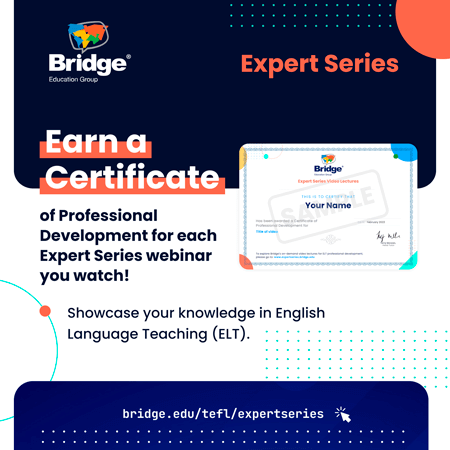
At Bridge, you can also stack your credentials, because your certificate will automatically update with the additional course hours every time you complete a TEFL/TESOL course.
How do I choose the best TEFL certification institution?
It’s not uncommon for aspiring English teachers to wonder which TEFL/TESOL course they should take. After all, many certification courses seemingly offer the same features and benefits. So, how can you know whether a TEFL/TESOL course will provide quality training and earn recognition from schools and companies? Here are the most crucial factors to consider:
-
The accreditations and affiliations that your certificate carries.
-
The course provider or institute’s background and track record in the market.
-
The number of coursework hours.
-
The job placement assistance the company provides.
Learn more about choosing the best TEFL/TESOL certification for you.

What types of TEFL courses are there?
When you browse TEFL courses, you may notice that there are different categories, course titles, and content. This variety mainly exists because each course serves a particular purpose and equips you with the skill set you need at a specific stage in your career. Let’s look at the different types of TEFL/TESOL certifications and who they’re for:
-
Professional certification: These courses are typically recommended for newcomers to the TEFL field, experienced teachers who are not yet TEFL/TESOL certified, and English teachers who want to refresh their knowledge of teaching concepts and methodologies.
-
Specialized certification: These courses focus on providing targeted training and work best for current TEFL-certified teachers who want to develop their skills in a specific area, such as teaching English online or teaching young learners. These programs also let teachers build a teaching niche and make their resumes stand out.
-
Micro-credential courses: These bite-sized professional development courses are made for English teachers who want to explore new ideas and techniques to teach particular topics or use certain teaching strategies more effectively. For example, topics include teaching English pronunciation and teaching TOEFL test prep.
A TEFL certificate does more than prove course completion. It shows employers that you have taken the profession seriously and that you have built a foundation for teaching with confidence and credibility.
How many hours of TEFL certification do I need, and how long does it take to get a TEFL certificate?
Though TEFL/TESOL course hours vary, online and in-person English teaching jobs typically look for a professional TEFL/TESOL certification with at least 120 hours to show that you’ve received comprehensive training in the theoretical and practical aspects of English teaching.
Most TEFL/TESOL courses are also self-paced and usually include a time frame within which you’re allowed to finish the course. This setup is ideal because you can choose to dedicate more time to studying if you’d like to get your certificate faster! Bridge’s 120-hour Master TEFL Certificate course, for example, can be completed in up to three months, but you can also finish it in just six or eight weeks!
If you decide to work toward a graduate-level degree, Bridge’s university-affiliated 150-hour International Diploma in English Language Teaching (IDELTOnline™) Certification allows you to earn credit toward a pathway for a Master’s TESOL degree.
The good news is that you do not need to put your life on hold to get certified. With the right course and schedule, you can build meaningful qualifications at a pace that works for you.
How does online TEFL certification work?
Nowadays, most TEFL/TESOL courses take place online, and the vast majority of employers do not see any difference between in-person and online certification. The main perk of taking an online TEFL course is flexibility, as you can study at your preferred place and time!
When you enroll in one of Bridge’s online TEFL courses, you can start on the same day most of the time. The course takes place on an interactive learning platform, where you can read and even download your course materials. Aside from this, you’ll also watch videos, take quizzes, participate in discussion forums, and even interact with and get feedback from your personal tutor.
Online certification makes professional training more accessible and more flexible for future teachers everywhere. If you need a format that fits around work, study, or daily life, this route can make your next step much easier to take.
Get answers to frequently asked questions about online TEFL certification.
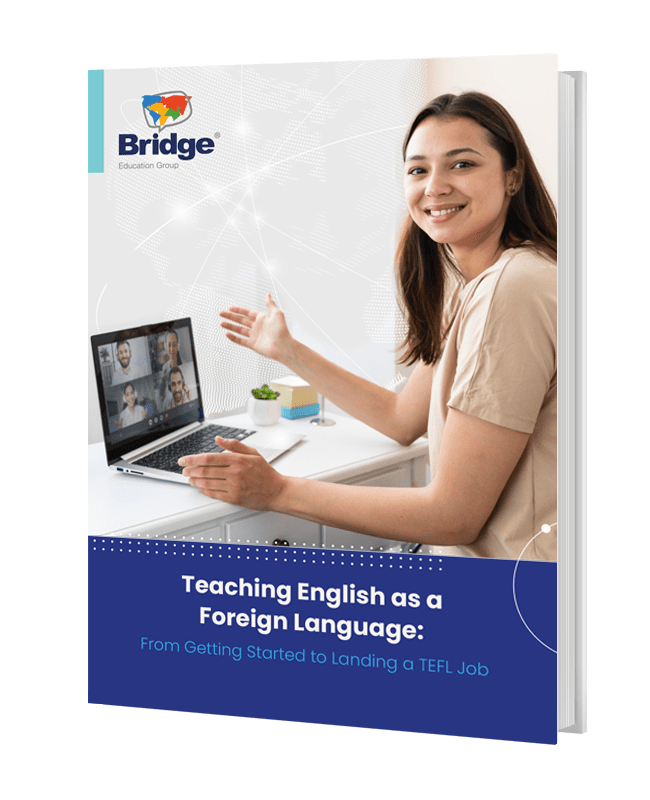
Launch your TEFL journey and score your dream job with our free eBook:
Teaching English as a Foreign Language
DownloadWhat jobs can I get with TEFL certification?
A lot of work opportunities await you as a TEFL-certified teacher! Do you want to teach in a physical classroom? No problem. Do you want to become a digital nomad and travel the world while teaching English online? You can find jobs for that, too.
Aside from teaching English as a foreign language, your TEFL certification can also open other ESL/EFL career paths for you. For example, you can become a teacher trainer, a curriculum developer, or an IELTS test examiner. You can also become an independent teacher or a teacherpreneur and run your own ESL teaching business.
With a professional certificate, you can land teaching English as a foreign language jobs in:
-
Public schools
-
Bilingual and international schools
-
Language institutes
-
Online ESL companies
TEFL certification can lead to much more than one type of classroom or one type of job. As your skills grow, your options grow too, and that is where things start to get interesting.
How much does a TEFL job pay?
There are many types of TEFL jobs, and pay ranges can vary greatly depending on where you teach, how you teach, the requirements of the job, and your experience level. TEFL jobs like those at a university that require an advanced degree and experience will naturally pay more. Tutoring online through a marketplace will have a lower hourly wage but offer the benefits of a flexible schedule. Teachers who specialize in niche subjects, like teaching IELTS Exam Prep, can charge more and increase pay potential.
TEFL salaries abroad will also depend on location. Keep in mind that while some countries pay higher salaries, the cost of living may also be higher. The reverse is also true. Some jobs also include benefits that you should factor into pay. For example, if you are teaching abroad, a job that includes a housing allowance will help your pay go a lot farther.
Let’s look at some example pay ranges.
Teaching for a public school, bilingual or international school, or language institute also has a wide range of pay that your location, education level, certification, and experience can impact. You may find jobs like these where you live or by teaching English abroad. Here are some examples of potential monthly pay in several countries:
-
Portugal: $860 – $1,600
-
Spain: $1,300 – $1,600
-
Thailand: $1,000 – $1,500
-
South Korea: $1,600 – $2,100
-
Argentina: $600 – $1,400
-
Colombia: $800 – $1,100
-
Qatar: $2,400 – $4,500
-
Morocco: $800 – $1,100
A typical salary for teaching English online starts at $10 – $20 per hour and can increase to up to $40/hour with credentials and experience. If you are just starting or teaching part-time, you can expect to make between $10 – $15 per hour, but finding a niche and gaining experience will quickly boost your salary.
You can also start your own online English teaching business, build your own portfolio of students, choose the courses you offer, and set your own rates. Similar to other online English teaching jobs, you may start by offering lower hourly rates, but as your business grows and you can offer niche services, you can charge higher rates.
TEFL income depends on the path you choose, the skills you build, and the market you enter. Your earnings can grow as you gain experience, specialize, and expand your opportunities.
How do I become a TEFL teacher?
Getting started in English teaching is not difficult at all! Here’s how you can set up your TEFL career.
-
Decide where and how you want to teach English. Do you want to teach in person or online? Would you like to begin with a company or as a freelancer?
-
Create your TEFL resume. Don’t forget to highlight your credentials and skills and include your digital badges.
-
Apply to jobs. You can send your resume and other requirements directly to the best English teaching companies through job platforms. Depending on the employer, you may have to wait a few days before moving on to the next step of the application process.
-
Start teaching!
Now that you know what TEFL and certification are all about, you’re already one step closer to reaching your English teaching goals! By choosing the right TEFL/TESOL certification for yourself, you’ll no doubt be able to teach with confidence – wherever that may be.
Becoming a TEFL teacher starts with a few clear steps and a practical plan. Once you choose your direction and get certified, you can begin building a teaching career that matches your goals, your lifestyle, and your strengths.
TEFL can open the door to a flexible, global, and rewarding career, but real progress starts with the right preparation. When you understand the field, choose solid training, and build the skills employers value, you give yourself a clear path forward. Whether you want to teach abroad, teach online, or create your own niche in English education, TEFL certification can help you move from interest to action with confidence.